
Bengaluru: The India Payments Landscape has attracted approximately $5.8 billion across 371 disclosed equity funding rounds since January 2021, as the payments ecosystem built around the Unified Payments Interface (UPI) continues to expand.
According to a new report by Tracxn, consumer-facing payment applications accounted for the majority of the funding, while business payments and payment infrastructure companies attracted the remaining capital.
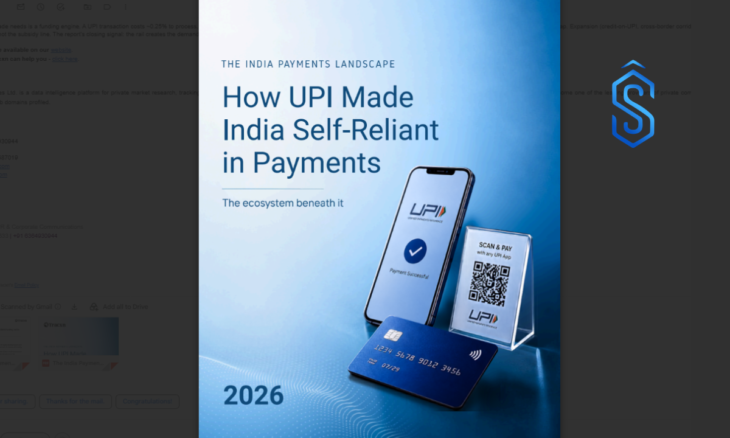
Tracxn, a global market intelligence platform for private company data, has released The India Payments Landscape: How UPI Made India Self-Reliant in Payments, a report analysing the payments ecosystem built around UPI, including capital raised, exits and cross-border expansion.
The report found that payments companies have raised approximately $5.8 billion across 371 disclosed equity rounds since 2021.
The sector has also recorded eight IPOs and 25 acquisitions, with funding and acquisitions increasingly concentrating around a relatively small number of well-funded companies.
The India Payments Landscape has developed around a public payments rail that charges merchants nothing, helping create demand for a private ecosystem of payment applications, infrastructure providers and related financial services.
Consumer Apps Account for Majority of Funding
The funding distribution across the India Payments Landscape shows a clear preference for consumer-facing payment businesses. Consumer payments companies accounted for approximately 53% of the capital raised, equivalent to around $3.1 billion.
Business payments companies accounted for approximately 38% of funding, or around $2.2 billion.
The enabler layer, comprising APIs, switches and infrastructure that supports the payments ecosystem, attracted approximately 9% of the capital, or around $526 million.
Funding peaked during the 2021 boom before correcting through the 2022 to 2024 period. The report noted a tentative recovery in 2026, driven in part by CRED’s $540 million funding round.
Despite the overall funding volume, capital remains highly concentrated. CRED and PhonePe each attracted roughly $1 billion during the period covered by the report, while Pine Labs raised $641 million, Razorpay secured $535 million and BharatPe received $440 million.
Together, these five companies accounted for approximately 66% of disclosed funding in the India Payments Landscape since 2021.
The concentration indicates that a significant share of investor capital has gone to scaled category leaders rather than being distributed evenly across the broader ecosystem.
Also Read: Favara-UPI Cross-Border Payment Corridor Goes Live Between Maldives and India
Paytm, PhonePe and CRED Lead Lifetime Funding
Looking beyond funding raised since 2021, the ten best-funded companies in the India Payments Landscape have raised approximately $9.4 billion over their lifetimes.
Paytm leads the table with approximately $2.8 billion in total funding, followed by PhonePe with $1.7 billion and CRED with $1.5 billion.
The capital has flowed across several segments connected to the UPI ecosystem, including payment service providers (PSPs), third-party application providers (TPAPs), merchant acquirers, UPI-linked credit businesses and the underlying payments infrastructure.
The concentration of capital among major companies has been accompanied by a rise in exits, indicating a shift in the maturity of the India Payments Landscape.
Payments Ecosystem Records Eight IPOs
The payments sector has recorded eight IPOs since 2021, providing another indication of the evolution of the India Payments Landscape.
Paytm, which listed in November 2021, and Pine Labs, which listed in November 2025, were among the major payments companies to enter public markets. MobiKwik and Zaggle also featured among the sector’s public-market exits.
The emergence of these IPOs represents a shift for an ecosystem that previously relied predominantly on private funding rounds. Public markets are now absorbing home-grown payments companies at scale.
The report identified consolidation through acquisitions as another major exit route. Notably, companies that have themselves received significant funding are increasingly becoming acquirers within the India Payments Landscape.
Razorpay acquired Ezetap for $200 million and IZealiant, while Pine Labs acquired Setu for $75 million and Mosambee. M2P, Juspay, PayU and Perfios have also acquired businesses and capabilities.
According to the report, these transactions are allowing companies enabled by UPI to internalise capabilities around their platforms, contributing to consolidation across what was previously a more fragmented ecosystem.
India Payments Landscape Expands Beyond Domestic UPI
The evolution of the India Payments Landscape is also extending beyond India’s domestic payments market through the international expansion of UPI-linked infrastructure.
Cross-border UPI transactions increased more than 20-fold in a single year, rising from approximately 37,060 transactions in FY24 to more than 7.5 lakh in FY25. The payments rail is now live in more than 12 countries.
NPCI International is transferring India’s payments capabilities internationally through three modalities.
The first involves connecting existing payment systems, including Project Nexus, which involves the Bank for International Settlements (BIS) and four central banks.
The second involves building payment rails that partner countries own outright, including initiatives involving Namibia, Peru and Trinidad & Tobago.
The third involves sharing open standards, including Indonesia’s network based on the Beckn protocol.
The report described this expansion as the export of an operating capability rather than simply an application, highlighting the growing international dimension of the India Payments Landscape.
UPI Creates Demand for Private Payments Industry
The report’s findings place UPI at the centre of the India Payments Landscape. According to the report, UPI now accounts for close to half of the world’s real-time payments, at approximately 49%, based on ACI Worldwide data.
UPI processed approximately ₹314 lakh crore in FY26, with around 66 crore transactions taking place each day. This transaction base has created the demand conditions that have supported investment in India’s private payments industry.
The report’s central finding is that a public payments rail that charges merchants nothing has helped seed and scale a private industry above it. At the same time, a new law has reopened the question of how the payments rail itself should be funded.
Funding Model Emerges as Key Question
The future funding model is an important issue for the India Payments Landscape as the ecosystem expands into new areas.
A UPI transaction costs approximately 0.25% to process, while government incentives have covered only around 10% to 11% of that cost, according to the report.
The new Merchant Discount Rate (MDR) enabling provision represents the state’s attempt to address the funding gap.
At the same time, the report noted that expansion into areas such as credit-on-UPI, cross-border payment corridors, offline and feature-phone payment rails, and fraud defence has historically been financed by private capital rather than the subsidy line.
The report’s closing assessment is that the rail creates demand, while a funded commercial layer builds products around it. Maintaining the health of both elements will remain central to the future development of the India Payments Landscape.
India Payments Landscape Moves Toward Consolidation and Global Expansion
Overall, the India Payments Landscape has moved from a period dominated by private fundraising toward a more mature ecosystem characterised by funding concentration, public-market exits, acquisitions and international expansion.
Since 2021, payments companies have raised approximately $5.8 billion across 371 disclosed equity rounds, while the sector has produced eight IPOs and 25 acquisitions.
Consumer applications have attracted the largest share of funding, while a small group of leading companies has absorbed a substantial portion of the available capital.
With UPI supporting a large domestic transaction base and expanding internationally, the India Payments Landscape is now being shaped by both the continued development of private payment businesses and the broader question of how the underlying payments infrastructure will be funded as the ecosystem expands.